Yeast starter, sourdough, or levain – what is the difference between them
Feb 26, 2026

What is Yeast Starter, Sourdough, and Levain
My explanation of three words that each play a different role in dough.
In the world of slow baking, we often encounter three terms that sound similar but mean different things. Yeast starter, sourdough, and levain—they remind me of three brothers from the same dough, but each has a different personality. In this article, I would like to explain how I understand them, why it is important for me to bake bread from sourdough, and how each of these terms represents a different stage on the journey toward a loaf of bread. PSSST: Then there is also the mother culture, but more on that another time.
Yeast Starter (Kvásek) – A one-time starter
When grandma said "let's make a starter," she meant that well-known mixture of yeast, sugar, flour, and milk, which she let sit for a while until the mixture got going and could be used to leaven the dough. In Czech tradition, "kvásek" is often associated specifically with commercial yeast—it is a fast, one-time beginning for a yeast dough. You prepare it, use it, and it's gone. For many people, this is their first encounter with how dough wakes up—and the first step before they dive into baking with real sourdough. There is a catch, though. Hobby bakers often call "kvásek" that which contains only flour and water. Well, marketers take advantage of this and put a "...from kvásek" label on their pastries and breads, and we consumers then think it is a product that contains no commercial yeast. From now on, you'll know to check the product label as well. To your surprise (it certainly was to mine), it often contains not only sourdough but also commercial yeast and plenty of other additives. At least in some products.
Sourdough (Kvas) – A living organism
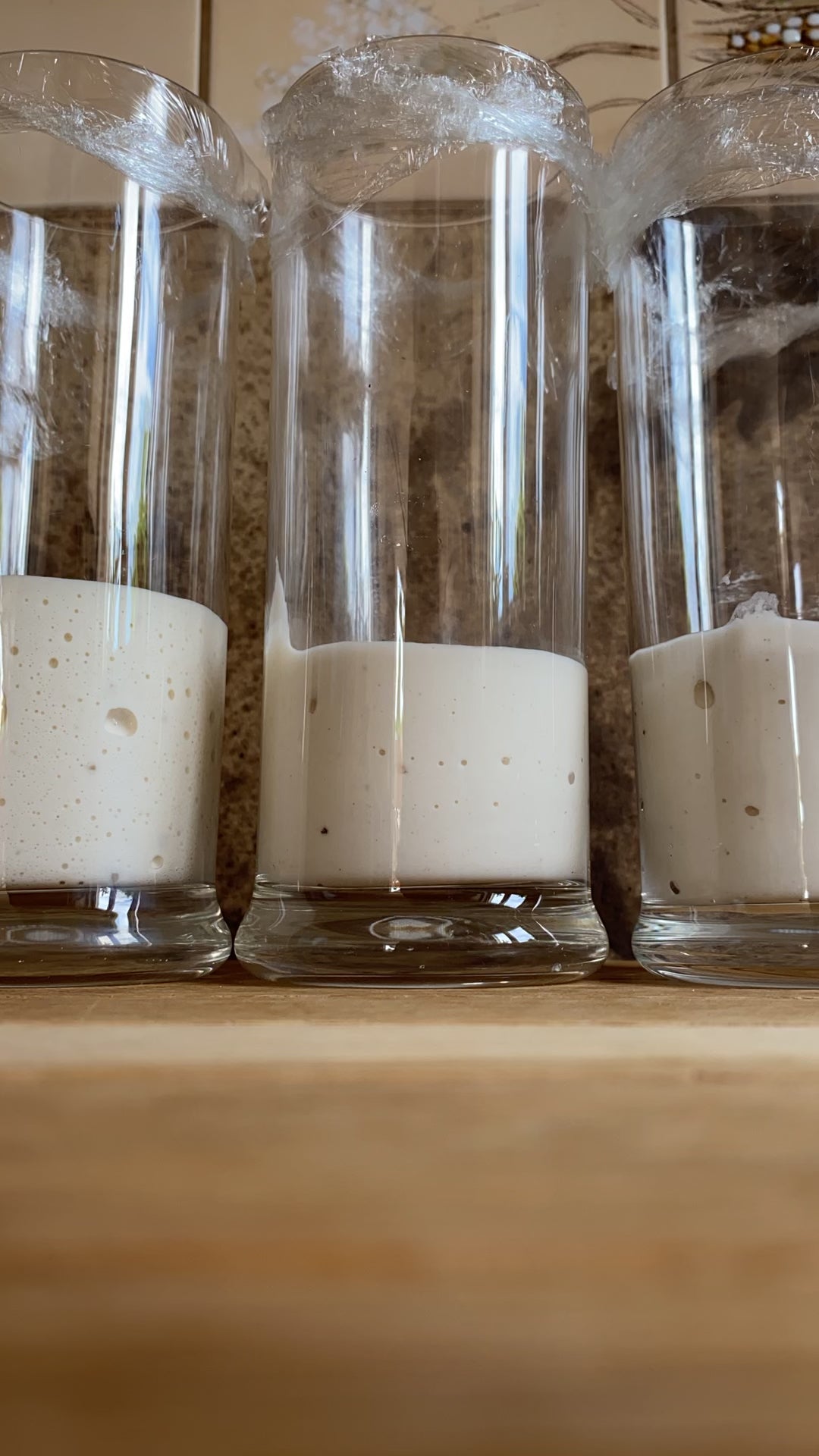
Unlike a simple yeast starter, sourdough is a long-term maintained culture of wild yeast and lactic acid bacteria. It is what bubbles in your jar day after day, what you feed with flour and water, what you sometimes forget to feed—and yet it forgives you and ultimately bakes you a wonderfully fragrant loaf. Sourdough is not a one-night stand. It is a commitment. Something like a pet that only needs flour, water, and a little love. And because sourdough is alive, it can create a dough with depth, structure, and flavor that commercial yeast can never achieve.
Levain (Rozkvas) – A prepared step toward the dough
And then there is the levain. This is the hard worker. A levain is created by taking a certain amount of your sourdough culture and feeding it with flour and water—according to a specific recipe—letting it work for several hours, and then using the whole amount in the dough. The levain is the stage where the sourdough shows its full strength and begins to create what we look forward to most—bread, a baguette, a cake, or perhaps a focaccia.
Why you are suddenly reading about "kvásek" here
You may have noticed that on Instagram and in my courses I often talk about sourdough (kvas), while here on the website you mostly read yeast starter (kvásek). It’s not a contradiction, but rather linguistic empathy. The web is full of people searching for the term kvásek—and they often use it as a term of endearment because they keep it at home like a little pet. I understand that; I used to be the same way. There was even a period when I refused to use the word "kvas." But baking school taught me a big lesson, so on social media I use the word kvas, which is more accurate and rooted in baking tradition. On the website, however, I work with what people naturally search for. For me, kvásek is a bridge—between your search query and my experience. Yet, we are talking about the same thing.

It depends on what they actually do in the dough. A yeast starter made with commercial yeast is fast. Sourdough needs time, but it gives the dough strength, flavor, and shelf life. And the levain? That wakes up the sourdough. Only enough levain is prepared to be fully used in a specific recipe. When you understand the difference, the bread will reward you—literally in every crust.
What you will bake from that levain
Bread that is not just a recipe, but a crunchy experience.
By understanding the differences between a yeast starter, sourdough, and levain, you will be able to bake real sourdough bread—without commercial yeast, with full flavor and structure. You will see how the dough starts to behave differently when you understand it. And at that moment, it will no longer be just baking. It will be a conversation between you, the dough, and the sourdough culture.
Happy baking!
Mari