


How often to feed sourdough, where to store it and when is the best time to bake?
Jun 29, 2025

Wondering, how often to feed your sourdough starter? Sourdough is a living organism. It needs regular care, the right temperature, and a clean environment. When you give it these, it rewards you with bread that no commercial bakery can match.
Yet, many people feed their starter either too often or not enough. They use it at the wrong moment. They store it where it’s not comfortable. And then they wonder why the dough won't rise, why the bread is flat, and why it has an unpleasantly sour taste. All it takes is understanding one principle: your starter will tell you when it’s ready. You just have to learn how to read its signals.
Just starting with sourdough? Download our free e-book on levain, where you'll find a complete step-by-step guide, including ratios and timing.
In this article, we'll look at how often to feed your starter, when to use it for baking, and where it thrives best. Whether you maintain rye, wheat, or both at once. And because you can bake much more than just bread from sourdough (pizza, focaccia, pancakes, brioche, or even doughnuts), this know-how will come in handy often.
Sourdough and Starter: Is there a difference?
Before we go further, let's stop at one thing many people don't distinguish. Kvásek is a common word we use in everyday speech. But technically, it is more accurate to say kvas (sourdough).
Sourdough is a mixture of flour and water inhabited by wild yeast and lactic acid bacteria. Together, they break down the starches in the flour into simpler sugars. The yeast produces carbon dioxide (which leavens the dough) and the bacteria create acids that give the bread its typical flavor and extend its shelf life. This process is called fermentation. And fermentation is the heart of all sourdough baking.
The diminutive term "kvásek" suggests something small and cute. In practice, however, you are working with a living culture that needs respect, attention, and regularity. That's why I will alternate both words in this article, but keep it clear in your heart: it is sourdough. Living, active, strong.
Rye versus Wheat Sourdough: Each has its own personality
Rye sourdough is like a steady old friend. It tolerates lower temperatures, isn't bothered by mood swings (or weather), and grows almost every time, even if you forget about it a bit. It’s ideal for beginners and rustic breads with a firm crust.
Wheat sourdough (levain), on the other hand, is delicate, smells fruity, and requires more care. It loves warmth and precision. It’s ideal for soft doughs, brioches, or milk breads. When you feed it correctly, it rewards you with a supple structure and lightness.
Why the difference? Rye flour contains more enzymes (amylases) that break down starch faster. Thanks to this, the sourdough "takes off" more easily, even in less ideal conditions. Wheat flour, in turn, has a stronger gluten network. This holds air bubbles better, but bacteria in wheat sourdough produce acetic acid faster. That's why wheat starter is more sensitive to timing and temperature.

It is entirely up to you how many sourdough starters you want to have at home and how often you will use them. Some bakers maintain only one, others keep rye and wheat separate. Both ways work.
How often to feed your starter?
This depends on one thing: where you store it.
Starter on the counter (Room temperature)
You need to feed it every 12 to 24 hours. Depending on the ambient temperature. In summer, when the kitchen is over 25 °C, fermentation speeds up and the starter needs feeding even more often. In winter, at temperatures around 20 °C, once a day is enough.
Rye starter can tolerate a longer interval than wheat. But both will thank you for regularity.
In wheat starter, acids accumulate faster, which slows down the leavening. You can tell by a sharp, vinegary smell. That's why I recommend regularly smelling your starter. Some people even taste it, and that's okay. The tongue is also a good indicator. A mild tangy taste is correct, a strongly sour or bitter one means: time to feed.
Starter in the fridge
It's often stated that feeding once a week is enough. But I recommend once every 5 days. Ideally, take the starter out of the fridge, let it sit on the counter for a while, feed it, and let it come to life. Then either return it or refresh it once or twice more, put it in the dough, and bake.
Before the actual baking, it's best to prepare a levain. This means two to three consecutive feedings at room temperature so the starter can properly "run". Why? Because in the cold, yeast activity slows down. They don't multiply as much. And their ability to leaven dough is weakened after being removed from the fridge. By making a levain, you give them time to multiply again and regain strength.
If you need a clear guide on how to handle levain and feeding to the last detail, download the free e-book, where it's explained very simply.

What happens in the sourdough during feeding (and why it matters)
Feeding isn't just "adding flour and pouring water". It's a restart of the entire ecosystem.
When you add fresh flour to the starter, you supply new starch. Enzymes in the flour (amylases) start breaking it down into simple sugars. Maltose, glucose. This is the fuel for the yeast.
The yeast consumes the sugars and produces carbon dioxide. This is the gas that leavens the dough. At the same time, lactic acid bacteria (Lactobacillus) convert sugars into lactic and acetic acid. Lactic acid gives a mild, yogurt-like acidity. Acetic acid gives a sharper, more distinct tone.
The ratio between these two acids depends on the temperature. Warmth (above 25 °C) supports lactic acid. Cold (below 20 °C) shifts fermentation towards acetic acid. That's why sourdough from the fridge can smell sharper. And that's why room-temperature levain plays such an important role: it balances this ratio back.
When you don't feed the starter often enough, the yeast consumes all nutrients. They start producing ethanol (that smelly surface). Bacteria will prevail over yeast. The pH will drop too low. And yeast does not thrive in such an environment. The result? A starter that lives, but doesn't leaven bread.
When is the starter ready for baking?
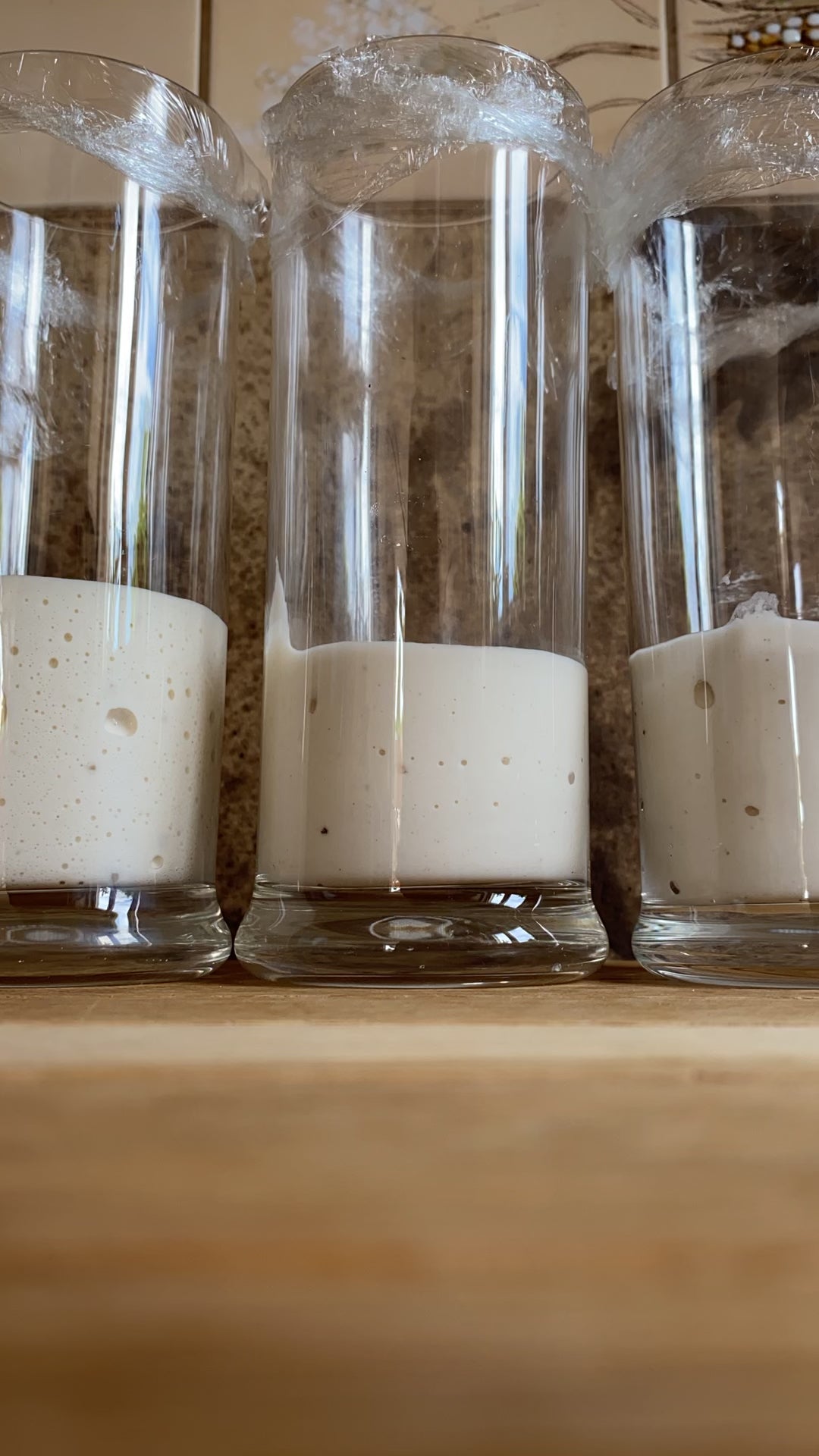
You can tell the right time by four things: bubbles, volume, surface shape, and smell.
The starter should be kept in a warm place and should double to triple its volume. Its surface should be slightly convex (we call this a "cap"). The smell should be light, fruity, and pleasantly tangy. When stirred with a spoon, it should be full of bubbles and feel fluffy.
It is best to use it 4 to 6 hours after feeding, when it's at its peak strength. You can read more in the levain e-book.
As soon as the surface starts to fall, it’s good to start another feeding or add it to the dough. At this stage, the starter is weakened: it has eaten what it had, and the dough could rise more slowly or have a more sour taste. Therefore, try not only what suits you but what bread you like. That, for me, is the alpha and omega of everything.
Where to store the starter so the bread rises as it should?
If you bake only once a week (maybe a weekend loaf), then the fridge is the ideal place between bakings. After use, feed the starter and put it back in the cold. Before the next baking, wake it up with a few feedings at room temperature. Just keep in mind that the temperature in the fridge is different on every shelf, at the front and back. Therefore, always put the starter in the same place that you have already tested. I just wouldn't put it in the door; it opens often.
However, once you bake twice a week or more, it’s easier to keep the starter on the counter. Feed it 2× a day, or more often if needed, and watch its behavior. Adjust the flour and water ratios and the number of feedings according to its strength. Rye starter handles longer intervals and less frequent feeding. Wheat needs precision and more frequent maintenance.
The fridge is only a temporary home
When you are about to bake, the starter must be awake and active. A chilled, slowed-down starter without regeneration won't leaven your bread correctly. But I'll admit: my dough has risen even when using starter directly from the fridge. Of course, differently and more slowly than I'm used to. Therefore, in these cases, I recommend: try what works for you.
This topic is often controversial among bakers, but it's worth touching upon. Personally, I had my starter in the fridge for a long time even when baking more often because it made sense to me at the time. But what I always do is smell the starter.
The starter will tell you very quickly by its smell. I look for a mild tangy, fruity scent. As soon as I smell vinegar, I know it's saying only one thing: I'm tired and need to be fed again.
That's also why I have a backup starter in the fridge. A small dose that I check twice a week and feed if necessary. Even in the cold, the starter continues to ferment, just more slowly. And when you take care of it, it always rewards you. Right now, wheat rules my kitchen and I feed it once a day.
At first, keep a regular sourdough diary and note down the smell of the sourdough, the rising time, and the kitchen temperature. Gradually, you'll learn to recognize what's happening with the starter, whether it will rise slowly or quickly. Typically by the sharpness of the sour smell.
Sourdough jar: Cleanliness first
Some prefer glass, others a plastic container. I say: whatever it is, just make sure it's clean. In a dirty jar, bacteria multiply that you don't have control over. Imagine it like cutting fresh vegetables on a board where you've just cut raw meat. Just no. Sourdough must have a clean environment.
Personally, I wash the jar regularly. I transfer the starter to a bowl and feed it there. Or I remove most of the starter, refresh it in the remainder, but eventually, I wipe the inside of the jar with a damp paper towel to remove remnants that stuck to the walls. It's a small thing, but this care makes a difference.
An ideal choice is a glass jar made of borosilicate glass. It doesn't absorb odors, is easy to clean, and allows you to watch the starter's activity from the outside. The acacia wood lid lets the starter breathe but protects it from dust and dirt.
Most common sourdough feeding mistakes
Feeding with water that's too cold
Yeast and bacteria are sensitive to temperature shocks. If you pour water straight from the tap (10–12 °C) into the starter, you'll slow down fermentation for hours. The ideal water temperature for feeding is 28–32 °C. It should feel pleasantly warm to the touch, not hot.
Wrong flour-to-water ratio
The most common ratio is 1:1 (equal weight of flour and water). But it's not a dogma. In summer, you can choose a stiffer starter (less water) because fermentation runs faster and a stiffer consistency naturally slows it down. In winter, on the other hand, a thinner starter (more water) will speed up fermentation slightly.
Skipping feeding "because it looks fine"
The starter may look alive, but bacteria may already be dominating over the yeast inside. The result: flat bread with an overly sour taste. Regularity is more important than perfect timing.
You can bake more than just bread with sourdough
Many people think that sourdough = bread. And they are partly right because quality sourdough bread is the foundation. But sourdough is a universal tool. It can be used to bake pizza, focaccia, pancakes, doughnuts, brioche, or even fruit cake. Sourdough fermentation improves the flavor and texture of practically any dough. The breakdown of starches and proteins during fermentation brings a depth of flavor to the final pastry that no yeast can replicate.
That's why it's worth keeping your sourdough starter in good condition. It's not just about one recipe. It's about a whole palette of baking that will open doors for you once you understand your starter.
The base is an active sourdough starter and the taste of the bread
Everything I'm writing here are my observations gathered over years of baking, observing, and also plenty of mistakes that brought me here. But as I say in my baking courses and follow in my own life: everyone has the choice to try what works for them. Only one thing applies: the starter must be active and the bread must taste good. If that's happening, you're on the right track.
But if you want to go deeper and become, for example, a professional baker, then a whole science awaits you. Ratios, pH, temperature curves... But everything has its time. And when it comes, I'll help you with it in my courses.
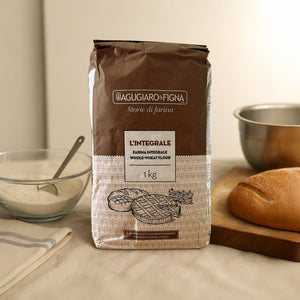
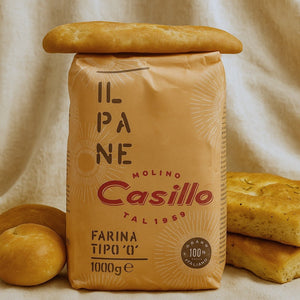
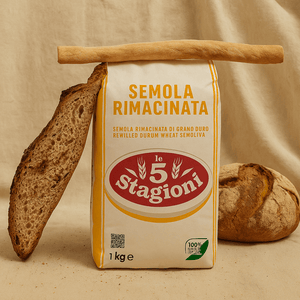
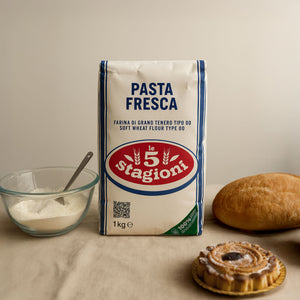
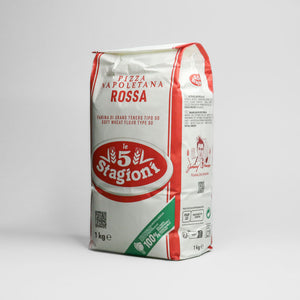
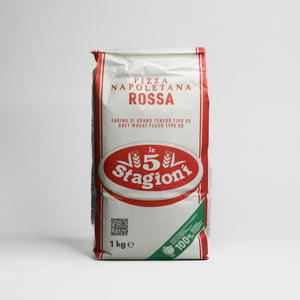
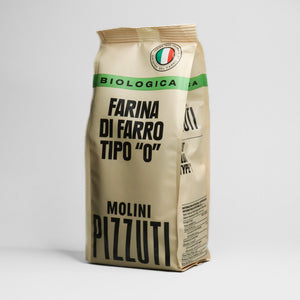
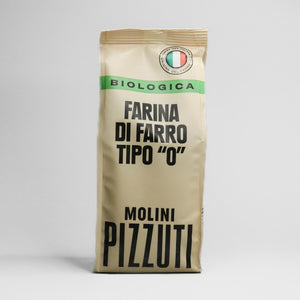
And if you want to make your first sourdough bread baking easier, start right away with our SUPER SET for home sourdough bread. Premium Italian flours selected exactly for sourdough baking, in one package.
Frequently Asked Questions
How often to feed the starter when it's in the fridge?
I recommend feeding the starter in the fridge once every 5 days. Take it out, let it temper on the counter for a while, feed it with fresh flour and water in a 1:1 ratio, and let it come to life for 1–2 hours at room temperature. Then return it to the fridge. Always prepare a levain with two to three consecutive feedings before baking.
How to tell when the starter is ready for baking?
An active sourdough starter doubles to triples its volume, has a slightly convex surface (the so-called "cap"), a pleasant fruity smell, and is full of bubbles when stirred with a spoon. The optimal window for use is 4 to 6 hours after the last feeding. As soon as the surface starts to fall, the starter's strength drops with it.
Can I use starter straight from the fridge without a levain?
Technically yes, but expect a longer rising time and more distinct bread acidity. Yeast is slowed down after cooling and needs time to start up. For the best results, I recommend at least two feedings at room temperature before adding the starter to the dough.
Why does my sourdough starter smell like vinegar?
A vinegary smell means the starter is hungry. Bacteria have started to dominate over the yeast because nutrients (starch from the flour) have run out. The solution is simple: feed it with fresh flour and water, ideally twice in a row at an 8–12 hour interval. After two to three feedings, the smell should return to pleasantly fruity.
What is the difference between "kvas" and sourdough starter?
In practice, it’s the same thing. "Starter" is the English term, "kvas" is the Czech equivalent. Both refer to a mixture of flour and water inhabited by wild yeast and lactic acid bacteria, which you continuously feed and use for leavening dough.
Read more
Baking School: All the basics of home bread in one place
Weekend baking recipes: from bread to sweets
Baking courses by Mari: learn the principles, not just recipes
















Diskuze
Děkuji moc za E-Book, zkusila jsem založit vlastní kvásek a zkusím péct poprvé domácí kváskový chléb.