When to bake Mazanec? Planning vs. Tradition
Mar 21, 2026

Every year, the same scenario unfolds. It's the Wednesday before Easter, you're standing in the kitchen wondering if there's still time for Mazanec, or if it's already too late. The answer depends on what you expect from your Mazanec and what kind of flour you have at home.
The question of when to bake Mazanec has two levels: the traditional one, which reaches deep into Czech history, and the practical one, which we deal with anew every year. I’ll break down both for you today so that next Easter (or even a random October Sunday) you can handle it calmly and without stress.
Just starting with home baking? Download our free levain e-book, where you'll find everything you need for the first step.
The tradition of baking Mazanec: from Holy Saturday to today
If we want to stick to our grandmothers' traditions, the right day for baking Mazanec is Holy Saturday. It was on this day that the long forty-day fast ended, and housewives prepared festive pastries for Easter Sunday. On Sunday morning, the Mazanec was taken to church to be blessed, which is where the folk name svěcenec (consecrated bread) comes from.
The original Mazanec didn't look at all like the one we know today. It was an unsweetened white bread. In those times, white flour itself was a luxury. It only began to be sweetened later, and the wealthier the family, the more egg yolks and saffron went into the dough to give the loaf a beautiful golden color.
Interesting fact: the name "mazanec" likely comes from the word "mazat" (to grease/brush), as the dough was brushed with egg, and it is among our oldest types of ceremonial pastries, documented as far back as the 15th century. In some regions, it was called "svěcenec" because it sat in a basket under a white cloth on the way to church.
When to start preparing the Mazanec dough
Nowadays, we plan our baking more according to free time and the shelf life of the baked Mazanec. The two most common scenarios are as follows:
Friday or Saturday?
The ideal time for baking is one to two days in advance, most often on Good Friday or Saturday morning. Mazanec is a rich, high-fat dough full of butter and egg yolks, so it doesn't need to "rest" like Christmas cookies. It is best when fresh, moist, and fragrant.
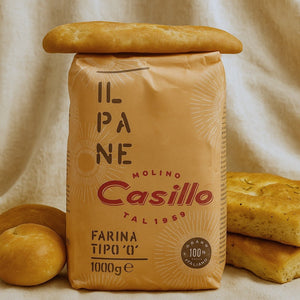
Baking on Friday has one big advantage: it leaves Saturday free for preparing the stuffing, coloring eggs, and everything else that belongs to Easter. If you use high-quality flour with a higher protein content, such as our Il Pane, the Mazanec will stay in great condition for up to four days. Friday baking won't jeopardize your busy weekend at all.
Morning or evening preparation?
Do you want Mazanec for Sunday breakfast? Prepare the dough on Saturday evening. Thanks to slow proofing (fermentation—the process where yeast gradually breaks down sugars in the dough and creates carbon dioxide), the dough has time to develop full flavor. In the morning, you just shape the loaf, let it rise, and bake.
Furthermore, slow proofing overnight improves the structure of the crumb. The yeast works more slowly, creating a finer network of bubbles, and the resulting Mazanec is fluffier. This is precisely why professional bakers let yeast doughs mature overnight in a cool place.
Why flour matters more than you think
This is where we get to what distinguishes a Mazanec that is dry the next day from one that still tastes great on Wednesday. The answer lies in the flour, specifically its protein content.
Proteins in wheat flour (mainly gliadin and glutenin) create gluten upon contact with water (a network of elastic fibers that holds the dough together and traps proofing gases). The higher the quality of the gluten, the better the dough retains moisture inside. And moisture is exactly what determines whether your Mazanec is still moist on the third day or resembles a cork stopper.
Common supermarket flour usually has around 9–10% protein. Our Italian Il Pane flour has a significantly higher protein content, which means a stronger gluten network, better moisture retention, and a longer shelf life without losing its softness.
For Mazanec, it is ideal to combine Il Pane (for the stability and height of the loaf) with Farina per Dolci flour (for delicacy and a tender crumb). Il Pane ensures the Mazanec doesn't spread sideways, while Farina per Dolci gives it that silky texture you know from Italian bakeries.
If you're interested in how different flours differ and why you should choose the right one for a specific type of baking, I have a separate guide for you.
The role of fat in yeast dough
The butter in Mazanec doesn't just play a role in flavor. Fat attaches to the gluten chains and "lubricates" them. Thanks to this, the crumb is delicate and the Mazanec stays soft longer. At the same time, however, fat slows down gluten formation because it prevents proteins from bonding with each other.
Therefore, it is important to add butter to the dough last, when the gluten is already partially developed. First, the flour combines with water and yolks, the gluten begins to develop, and only then is it the butter's turn. This principle is followed by bakers all over the world and works reliably in the home kitchen as well.
If you're not sure how to replace semi-coarse (polohrubá) flour, I’ll advise you in another article.
Mazanec isn't just an Easter affair
You might be wondering why limit yourself to Easter. In essence, Mazanec is a luxurious round brioche that works as a weekend breakfast all year round. While Vánočka is associated with braiding strands and winter, Mazanec is much simpler to prepare due to its shape.
Just leave out the traditional cross and you suddenly have a universal fluffy loaf that tastes great with homemade jam, with butter for coffee, or just on its own. Try it during a rainy October or on an August Sunday when you feel like baking but don't want to spend hours braiding a Vánočka.
What to do with Mazanec when it gets a bit dry
If you have a piece of Mazanec left over and in a few days it's no longer in condition to be sliced for breakfast, you have several options to transform it into another delicacy.
Mazanec French Toast: Slice the Mazanec, dip in a mixture of beaten egg and milk (add a pinch of cinnamon and vanilla sugar), and fry in a pan with butter on both sides. Serve with Greek yogurt and fresh fruit.
Mini Bread Pudding: Cut the Mazanec into cubes, lightly toast them in butter, and pour vanilla custard over them. You can easily make just a small portion for one. The result will surprise you. In the 20 years I've been baking Mazanec, this has only happened once because the Mazanec usually disappears before it can get dry.
Buns with Custard: Cut the Mazanec into 3x3 cm cubes and toast them in butter on all sides. Pour vanilla custard over them and sprinkle with ground poppy seeds. A simple, fast, and unexpectedly good variation.

If you're baking Mazanec for the first time and are afraid it won't hold its shape, try baking it in a round cake tin (diameter 22–24 cm). The tin will support it from the sides, preventing it from spreading, and you'll have the confidence of bringing a beautiful, tall loaf to the table. Next time, you won't even need the tin.
Frequently Asked Questions about baking Mazanec
When is Mazanec traditionally baked?
Traditionally, Mazanec is baked on Holy Saturday, the day before Easter Sunday. Housewives prepared it so it would be fresh for Easter Day (Boží hod), when it was taken to church to be blessed. Today, most households bake on Friday or Saturday morning, depending on their schedule.
How long does homemade Mazanec stay fresh?
It depends on the flour and the amount of fat in the dough. With common supermarket flour, Mazanec stays moist for 2–3 days. With high-quality Italian Il Pane flour, which has a higher protein content, you can count on 4 days without losing moisture. Keep it wrapped in a clean tea towel or in parchment paper in a cooler place.
Can Mazanec be baked outside of Easter?
Yes, and it’s definitely worth it. Mazanec is essentially a luxurious brioche. Just omit the cut cross and you have a fluffy loaf for weekend breakfast any time of the year. It works great with butter and jam, or even just with coffee. If you're looking for a proven method, I have my favorite homemade Mazanec recipe for you.
Why does my Mazanec crack in the oven?
The most common causes are insufficient proofing before baking, weak flour with low gluten content, or an initial oven temperature that is too high. Cutting a cross on the surface before baking helps because it gives the steam inside the dough a controlled exit. I break down all the causes and solutions in the article why Mazanec cracks and how to avoid it.
How to correctly store Mazanec?
After it has completely cooled, wrap the Mazanec in a clean cotton tea towel or in parchment paper. Do not use a plastic bag, as moisture accumulates in it and the crust softens. Store in a cooler place, like a bread box. If you bake in advance, you can even freeze the Mazanec. Slice it, wrap in plastic wrap, and store in the freezer. Thaw at room temperature.
So, do you know when you'll bake your Mazanec? This year, try it a day earlier than you're used to. You'll see how much stress it saves you. And if you want to make baking easier, start right away with our Set for Fluffy Sweet Baking, where you'll find both flours from this article in one package, perfectly tuned to each other.
Now that you know when the right time is to start the dough, check out how long to bake Mazanec, or why Mazanec likes to crack in the oven and how to avoid it this year. And if you don't have a proven recipe yet, here is my favorite one.
Enjoy your meal! warmly, Mari
Read more