Why does Mazanec crack? 8 mistakes you might encounter
Mar 21, 2026

You spent half a day pampering the dough, proofing, and monitoring the temperature. And then you pull a loaf out of the oven that looks like someone stepped on its head. Cracks on the sides, a torn top, a bulging side. Instead of a showstopper Mazanec, you have a small disaster on your baking sheet.
And yet, you followed the recipe exactly. So why does Mazanec crack, even when you do everything right? The answer usually isn't one single mistake, but a combination of small details that add up. Today, I’ll break them down for you one by one, so this year you can pull a loaf out of the oven without a single unwanted crack. Unwanted, I emphasize.
Just starting with home baking? Download our free levain e-book. Even though it's about sourdough, the principles of working with flour and proofing apply universally.
What happens inside the dough when Mazanec cracks
Before we dive into specific mistakes, it helps to understand what’s actually going on in the oven. Mazanec dough contains a network of flour proteins that, upon contact with water and kneading, create gluten (an elastic structure that holds the dough together and traps gases from proofing). In Mazanec, this network is weakened by fat and sugar, as both of these ingredients prevent the gluten strands from bonding tightly.
When you put the Mazanec in the oven, the yeast produces even more carbon dioxide in a final burst. The water in the dough begins to turn into steam. Both push the crumb (the interior) outwards. This rapid expansion is called oven spring. Meanwhile, the surface of the dough begins to firm up due to high temperatures and the Maillard reaction (the reaction between sugars and proteins that creates the golden crust).
A crack always occurs where there is an imbalance. The interior expands faster than the crust can stretch. The surface finds the weakest point and—snap. There it is. All eight causes we’re about to cover lead to this very imbalance. And each has a concrete solution.
8 reasons why Mazanec cracks (and how to prevent it)
1. Temperature circus in the ingredients
If you use milk and eggs straight from the fridge and butter that's only quickly softened, you're creating a problem right at the start. The yeast will be in shock and wake up unevenly. In the oven, some parts of the dough will then start rising faster than others, creating internal tension. The result? An ugly crack exactly where two differently proofed zones meet.
Solution: Take all ingredients out of the fridge at least an hour before baking. Warm the milk until lukewarm (around 35 °C). The butter must be soft, but not melted. If you're unsure about the right temperature, a kitchen thermometer is an investment that pays for itself with every bake.
2. "Axes" hidden in the dough
It sounds strange, but what you put inside can destroy the Mazanec from the outside. Raisins and almonds sticking out of the surface act like little axes during baking. The dough around them isn't continuous, and as soon as it starts to grow in the oven, they slice it right where they're in the way.
Solution: Tuck all add-ins deep inside the loaf. The surface must be smooth. Add almonds for decoration only after brushing the Mazanec with egg yolk, and gently press them into the dough with a pastry brush so they meld with it.
3. Under-proofed dough
This is one of the few pieces of internet advice I agree with. An under-proofed Mazanec will grow powerfully in the oven because it wants to reach its proper size. The crust simply won't withstand that surge. And where there's a larger bubble or a slight surface imperfection, a crack will strike like lightning.
Solution: Let the dough proof on the baking sheet for an extra 10–20 minutes if needed, until it feels like a soft, fluffy pillow. A properly proofed Mazanec slowly regains its shape after a light finger press. If the indentation bounces back immediately, it needs more time. If it stays and doesn't return, the dough is over-proofed.
4. Lazy gluten
It’s not enough to have the right ingredients in the bowl. You have to force them to cooperate. If you knead the dough for too short a time, the gluten won't have enough time to develop and bond. The result is a fragile mass that lacks elasticity. When it starts expanding in the oven, it doesn't have enough stretch and cracks.
You can tell well-developed dough because it's velvety smooth and doesn't tear immediately when stretched. Try pulling off a small piece and stretching it between your fingers. If you see a translucent membrane (the windowpane test), the gluten is developed. If it tears instantly, it needs more work.
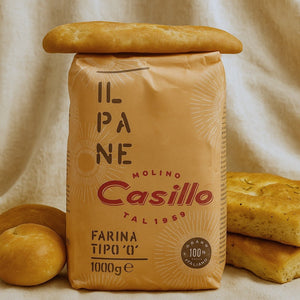
Solution: Give the stand mixer at least 15–20 minutes. If kneading by hand, count on 25 minutes. Use flour with plenty of protein, like our Il Pane, which creates a stronger gluten network even in dough weighed down by butter and sugar.
5. Dried-out crust during proofing
If the Mazanec proofs on the sheet completely "naked," its surface dries out and creates a firm, invisible crust even before baking. This dried layer doesn't stretch in the heat of the oven—it cracks.
Solution: Always protect the dough during proofing. Either cover it with a proofing cap or let it proof in a closed oven with a mug of hot water at the bottom. The moisture creates a humid microclimate and won't let the surface even think about drying out.
6. The "bread technique" is the biggest mistake
This is a major stumbling block. If you tighten the Mazanec during shaping like you would a loaf of bread, you create so much surface tension that the growing dough in the oven will simply rip the surface apart. Mazanec isn't bread. Its gluten network is weakened by fat and sugar. Unlike bread dough, which you want to tension as tightly as possible, Mazanec dough needs gentler handling.
Solution: Tighten only lightly, just enough for the Mazanec to hold its shape, but without the surface being stretched to the breaking point. Imagine you're shaping something delicate. No "aggressive rolling," just gentle tucking of the dough under itself until it gains a round shape with light tension.
7. Blocked vent
The traditional cross cut on top of the loaf is a symbol of Easter, but it's also a functional safety valve. If you don't make the cross or only scratch it lightly, the steam pressure will find another way out. Most often, it explodes at the bottom or looks messy on the side.
Solution: Don't be afraid to cut with a sharp knife or lame to a depth of at least 1 cm. This shows the dough where to grow safely. Cut quickly and decisively so you don't deflate the dough. Scissors work even better because they don't compress the surface, they snip it open.
8. Rushing the bake
If you slide the Mazanec into an oven that's too hot without steaming, the crust hardens instantly. But the interior is just starting to expand. The firm crust won't hold that pressure. It will crack like a shell.
Solution: Start at 170–180 °C (top and bottom heat) and steam the oven for the first 10 minutes. A bowl of hot water at the bottom or a few sprays from a spray bottle is enough. The moisture keeps the crust flexible until the interior finishes its oven spring. And forget about convection (fan) mode; it dries the surface even more aggressively. More on correct temperatures and times can be found in the article how long to bake Mazanec.
Which flour helps against cracking
When you overdo it with flour, the dough loses elasticity. It can't expand smoothly and gives way at the point of greatest tension in the form of a crack. But even the right amount of the wrong flour causes problems.
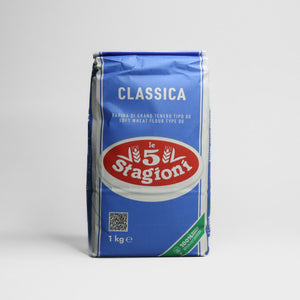
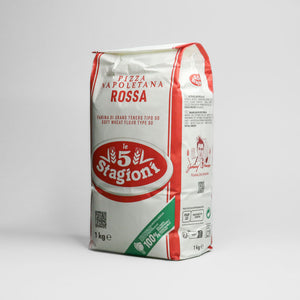
Ordinary supermarket flour has a lower protein content, so the gluten network is weaker. It can't withstand the pressure of butter, yolks, and proofing, so the dough spreads sideways or cracks. Our Italian Il Pane flour has a significantly higher protein content and creates stronger, more elastic gluten. The Mazanec then holds its shape, grows tall, and the surface stretches nicely instead of cracking.
Ideally, combine it with Farina per Dolci flour, which has less protein and softens the crumb. Strength from Il Pane, silkiness from Farina per Dolci. I use this combination in my homemade Mazanec recipe and it works reliably. Monitor the dough density; it should be elastic, not stiff. To the touch, it should be velvety smooth, non-sticky, and feel like something you want to squeeze and pet all day. That's the right dough.

Sometimes I tend to name things a bit differently than what's normal in recipe explanations. Axes, circus, blocked vent. It's so that you can look at baking in a different light. Playfully. Maybe you'll imagine those images and remember them next time you bake. It's useful to keep all of this in mind for Vánočka (Christmas braid) too.
Frequently Asked Questions about Mazanec cracking
Why does my Mazanec crack even though I cut a cross in it?
Scoring helps, but it doesn't solve everything. If the dough is under-proofed, the flour is weak, or the oven temperature is too high, the Mazanec will crack even with a cross. The cross is a safety valve, not a guarantee. It must work in conjunction with proper proofing, quality flour, and a gentle initial temperature.
Is it better to score with a knife or scissors?
Scissors. A knife can squash the dough, especially if it isn't razor-sharp. Scissors snip the surface without compressing it. The cut should be at least 1 cm deep so the steam has enough room to escape.
Does convection help against cracking?
No, quite the opposite. Convection dries out the surface of the dough more aggressively than classic top and bottom heat. The crust hardens faster and loses elasticity. For Mazanec, a classic mode at 170–180 °C with steaming in the first 10 minutes is preferable.
Can I still save a cracked Mazanec?
Taste-wise, yes; a Mazanec with a crack tastes exactly the same. Appearance-wise, you can hide it by dusting with powdered sugar or using a chocolate glaze. If your Mazanec cracks repeatedly, next time try a flour with a higher protein content and spend more time on proofing. Most cracking disappears with just these two changes.
Now you know why Mazanec cracks and how to prevent each cause. If you want to be sure it turns out perfect from start to finish this year, start right away with our Set for Fluffy Sweet Baking. Both flours in one package, perfectly tuned for Mazanec, Vánočka, and sweet buns. And if you'd like to bake directly with me one day, check out our baking courses in Prague.
Enjoy your meal warmly, Mari
Read more